

How Do Noise-Cancelling Headphones Work?
In everyday life, we often find ourselves in noisy environments: we are sitting on the bus, people are talking around us in the office, or the neighbor is mowing the lawn.
At times like these, noise-cancelling headphones come in handy, seemingly turning down the outside world with the press of a single button. The background noise does not necessarily disappear completely, but it becomes much less distracting, allowing us to hear music, podcasts, or phone conversations more clearly even at a lower volume.
But how can headphones make noise disappear? How do they know which sound we want to hear and which one we do not?
The solution is called active noise cancellation, abbreviated as ANC.
What Counts as Noise?
From a physical point of view, noise is the same kind of sound wave as music or human speech.
When an object vibrates, it moves the air around it. These small changes in pressure travel onward as waves and eventually reach our ears. Our eardrums begin to vibrate, and our brain interprets the signals it receives as sound.
Noise, therefore, is not some special type of sound. We generally call something noise when we do not want to hear it at that particular moment.
The monotonous rumble of a car engine, for example, is noise when we are listening to music, but for a mechanic, the same sound may also carry important information about the condition of the car.
Noise-cancelling headphones, of course, cannot know which particular sound annoys us personally. Instead, they try to recognize and reduce certain types of environmental sounds.
Passive and Active Noise Cancellation
There are two basic forms of noise reduction:
- passive noise cancellation
- active noise cancellation
The two methods can also work at the same time.
Passive Noise Cancellation
Passive noise cancellation does not require electronics or a battery. The headphones simply physically prevent external sounds from reaching our ears.
The cushions of a large pair of over-ear headphones, for example, partially isolate the ear canal from the environment. Earphones fitted with correctly sized silicone tips create a seal inside the ear canal. This works in a similar way to covering our ears.
Passive noise cancellation can be particularly effective at reducing higher-frequency sounds. These may include:
- the clicking of a keyboard
- the clattering of dishes
- certain parts of speech
- the sharper sounds of vehicles
The quality of its performance is greatly influenced by how precisely the headphones or earphones fit.
Active Noise Cancellation
Active noise cancellation, by contrast, uses electronics, microphones, and dedicated signal processing.
The headphones detect environmental noise and then create a sound wave that attempts to cancel it out.
At first, this may sound strange: the device actually adds another sound to the existing noise. However, when correctly generated, this opposing sound does not increase the noise but reduces the perceived noise.
How Can One Sound Cancel Out Another?
Imagine a regular water wave. The wave has high points, known as crests, and low points, known as troughs.
A similar alternation takes place in sound waves: the air pressure increases slightly and then decreases slightly.
If two completely identical waves arrive at the same place at the same time, their effects may add together. When one wave is rising and the other is rising in the same way, the result is a stronger wave.
However, if the crest of one wave meets the trough of the other wave exactly, the two effects may partially or even completely cancel each other out.
This is called destructive interference.
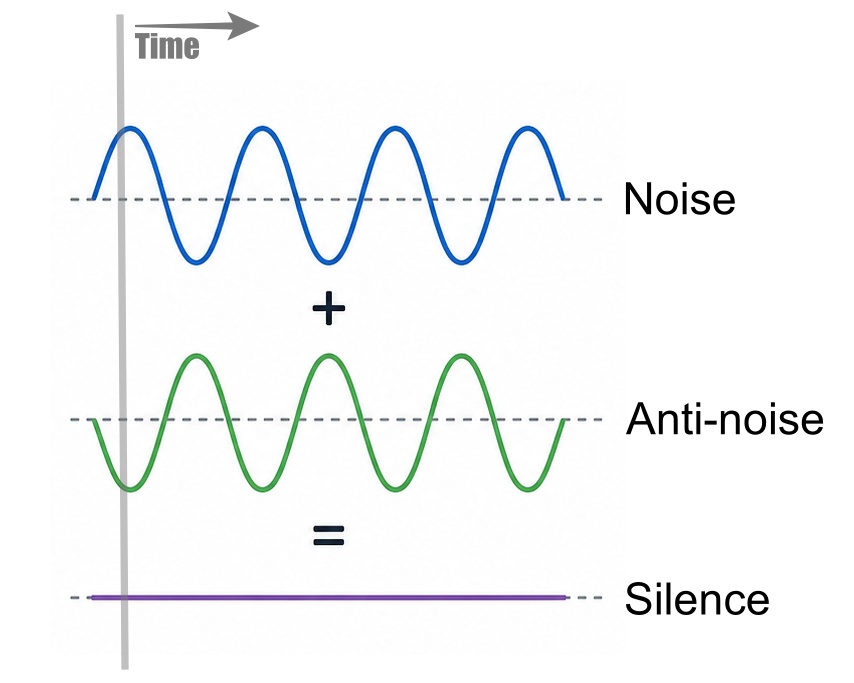
Active noise cancellation makes use of this phenomenon. The headphones generate a sound wave that is in the opposite phase to the external noise. This is often simply referred to as “anti-noise.”
In theory, if the original noise and the anti-noise match each other perfectly, the noise is completely cancelled out. In reality, however, noise is constantly changing, so complete silence is rarely achievable. The technology can nevertheless significantly reduce the intensity of certain sounds.
What Happens Inside the Headphones?
Active noise-cancelling headphones work in several steps.
1. The Microphones Monitor the Environment
There are small microphones on the headphones. These continuously detect environmental sounds.
Using the signals from these microphones, the system attempts to determine what kind of noise reaches the user’s ear.
2. The Processor Analyzes the Sound
The microphone signals are analyzed by a digital signal processing unit, or DSP, which stands for Digital Signal Processor.
Among other things, the processor examines:
- which frequencies make up the noise
- how loud it is
- how it changes over time
- what kind of opposing sound could cancel it out as effectively as possible
It must perform all of this extremely quickly. If the anti-noise reaches the ear too late, it does not meet the original sound correctly, and the noise reduction becomes less effective.
3. The Headphones Generate the Anti-Noise
The processor calculates a signal that matches the original noise but is in the opposite phase.
The speaker in the headphones plays this signal together with the music or speech. As a result, the following reach our ears at the same time:
- the noise coming from the environment
- the anti-noise generated by the headphones
- and the content we are listening to, such as music or a podcast
The original noise and the anti-noise partially cancel each other out, making the environment seem quieter.
The position of the headphones may, of course, change in the meantime, we may turn our head, or a different sound may suddenly appear in the environment, so noise cancellation does not perform just a single calculation. The system continuously monitors the microphones, recalculates the required opposing signal, and then adjusts its operation.
This process is repeated a great many times every second.
Which Noises Is It Effective Against?
Active noise cancellation is most effective against steady, lower-frequency sounds.
Examples include:
- the rumble of an airplane engine
- the engine noise of a bus or train
- the hum of an air conditioner
- the continuous rumble of distant traffic
- the constant background noise of an office
These sounds are relatively predictable, so the system can create a suitable opposing signal for them more easily. Lower sounds also have longer wavelengths, meaning that they have longer periods. Because of this, the small delay in the ANC electronics causes only a smaller phase error, which is why active noise cancellation is mainly effective against low-frequency noise.
This is why a good pair of noise-cancelling headphones can noticeably reduce continuous rumbling on an airplane.
Which Noises Are Harder to Filter Out?
Active noise cancellation has more difficulty dealing with rapidly and suddenly changing, higher-frequency sounds.
These may include:
- a door slamming
- a dog barking
- dishes clattering
- a nearby conversation
- a child crying
With these sounds, the system would have to detect the noise, calculate the opposing signal, and play it back within a very short time. By the time all of this happens, part of the sound has already reached our ears, and these types of noises also consist of constantly changing frequencies. Noise cancellation may reduce the volume of these sounds, but it generally does not make them disappear completely.
This is where passive noise isolation becomes important. Well-fitting ear cushions or silicone tips can physically dampen the higher-pitched sounds that the active system has more difficulty handling.
Good noise-cancelling headphones therefore do not rely only on electronics. Effective results require active and passive methods to work together.
What Should We Look for When Buying Noise-Cancelling Headphones?
The Design
Over-ear headphones can generally be comfortable during longer periods of use and can provide good passive isolation. At the same time, they are larger and heavier, and they may make the ears feel warm.
In-ear earphones are smaller and easier to carry. With a good fit, they can provide strong isolation, but this requires correctly sized silicone tips.
Comfort
A pair of headphones may be technically excellent, but if it presses against the head or ears, it will not be pleasant to use in the long term.
It is worth paying attention to:
- the clamping force of the headband
- the size of the ear cushions
- the weight of the device
- whether it can be used comfortably with glasses
- the stable fit of the earphones
Battery Life
Battery life should always be examined with noise cancellation switched on.
The figures provided by manufacturers may be affected by:
- the volume
- the Bluetooth connection
- the codec being used
- the strength of the ANC
- the number of phone calls
- the ambient temperature
Sound Quality
The strongest noise cancellation does not necessarily mean the best headphones.
When making a purchase, sound quality, comfort, microphones, battery life, and ease of use may be just as important as ANC performance.
The right choice depends on whether someone is primarily looking for a device for flying, commuting, office work, sports, or listening to music at home.
Common Misconceptions About Noise Cancellation
“Noise Cancellation Creates Complete Silence”
No. The technology primarily reduces certain steady, lower-frequency sounds. Sudden noises and human speech remain partly audible.
“The More Microphones It Has, the Better”
The number of microphones alone does not guarantee better noise cancellation. Their placement, the speed of the processor, and the quality of the algorithm are at least as important.
“Noise Cancellation Damages Hearing”
Properly functioning ANC is not dangerous in itself simply because it uses anti-noise. From the perspective of hearing, volume and the duration of use remain the main factors. In addition, when it is used outdoors, environmental dangers may be more difficult to notice.
“All Noise-Cancelling Headphones Work the Same Way”
The basic principle is similar, but the practical implementation may differ significantly. There may be differences in the microphones, the algorithms, and the physical isolation.
Featured Image source: AI