

PoE: One Cable for Both Data and Power
Installing an IP camera may seem like a simple task at first. We screw it onto the wall, connect it to the network, and it is ready to go. In practice, however, an inconvenient question immediately arises: where will it get power from?
Should we install a new power outlet? Or run an extension cord to the camera? Perhaps we should place the device where an electrical connection is already available?
Power over Ethernet (or PoE for short) solves exactly this problem. With this technology, network data and the electrical power required to operate the device can be transmitted through the same Ethernet cable, meaning that a single cable may be enough for both the internet connection and the power supply.
Power over Ethernet is therefore a technology that transmits not only data but also direct current through a standard Ethernet network.
With a traditional network connection, a device usually requires two cables:
- an Ethernet cable for the data connection
- a power cable for the power supply
When PoE is used, these two tasks are handled by a single network cable.
The technology is most commonly used with devices that would be difficult, expensive, or simply inconvenient to place near a power outlet. Typical examples include IP cameras, wireless access points (Wi-Fi access points), VoIP phones, and various smart building sensors.
The operation of PoE is defined by the IEEE 802.3 family of standards. Newer versions of the standard are capable of transmitting significantly more power than the first generation of the technology.
How does it work?
A PoE system essentially has two main components.
The PSE, or Power Sourcing Equipment, provides the electrical power. This is usually a PoE-capable network switch or a standalone PoE injector, which we will discuss later.
The PD, or Powered Device, is the device that receives and uses the power. This may be, for example, an IP camera or a Wi-Fi access point.
When a standards-compliant PoE device is connected to the network, the power source first checks whether the device on the other end is actually PoE-compatible. Only then does it begin supplying power.
This is important because it prevents full supply voltage from being applied automatically to the cable when a conventional network device that does not support PoE is connected. A standards-compliant system also uses detection, power classification, and shutdown mechanisms.
What is a PoE injector?
The power required by the Powered Device must therefore be supplied by something—the Power Sourcing Equipment. In most cases, this is a switch, but if our switch is not capable of providing PoE, we do not necessarily need to replace it just because we want to use a single PoE device. You can read more about network switches in <—this—> article.
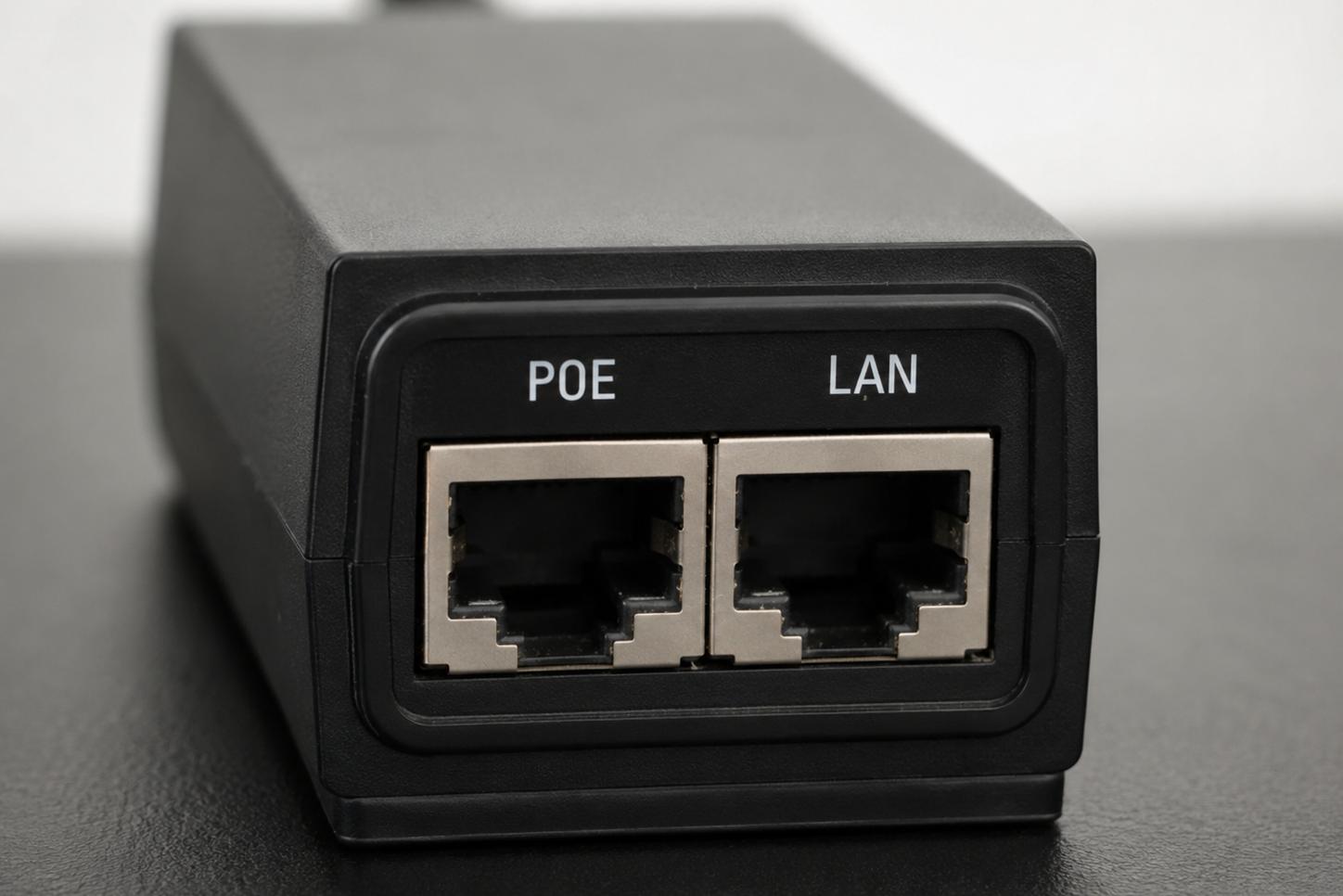
A PoE injector provides a solution to this problem.
An injector is a small intermediate device with two incoming connections:
- the network Ethernet cable from the conventional switch;
- the electrical power cable from the power outlet.
From the injector, a single PoE-capable Ethernet cable continues to the end device.
This can be a good solution, for example, if we only want to operate one outdoor camera or one ceiling-mounted Wi-Fi access point in a home network. When many devices are involved, however, it is usually more practical to use a switch with multiple PoE ports.